Every Crucible school runs on The Forge — the platform where students hand in real work, classmates and teachers verify it, families see the record, and the school can see how it is doing. Not a lesson player. Not a gradebook. The working floor of a school built for formation.
Built by The Crucible Institute. Running live in partner schools today. Included in every Crucible partnership — there is no separate software fee.
A Crucible school keeps a few of its own words on purpose. The everyday meaning comes first on this page; the school's word rides alongside.
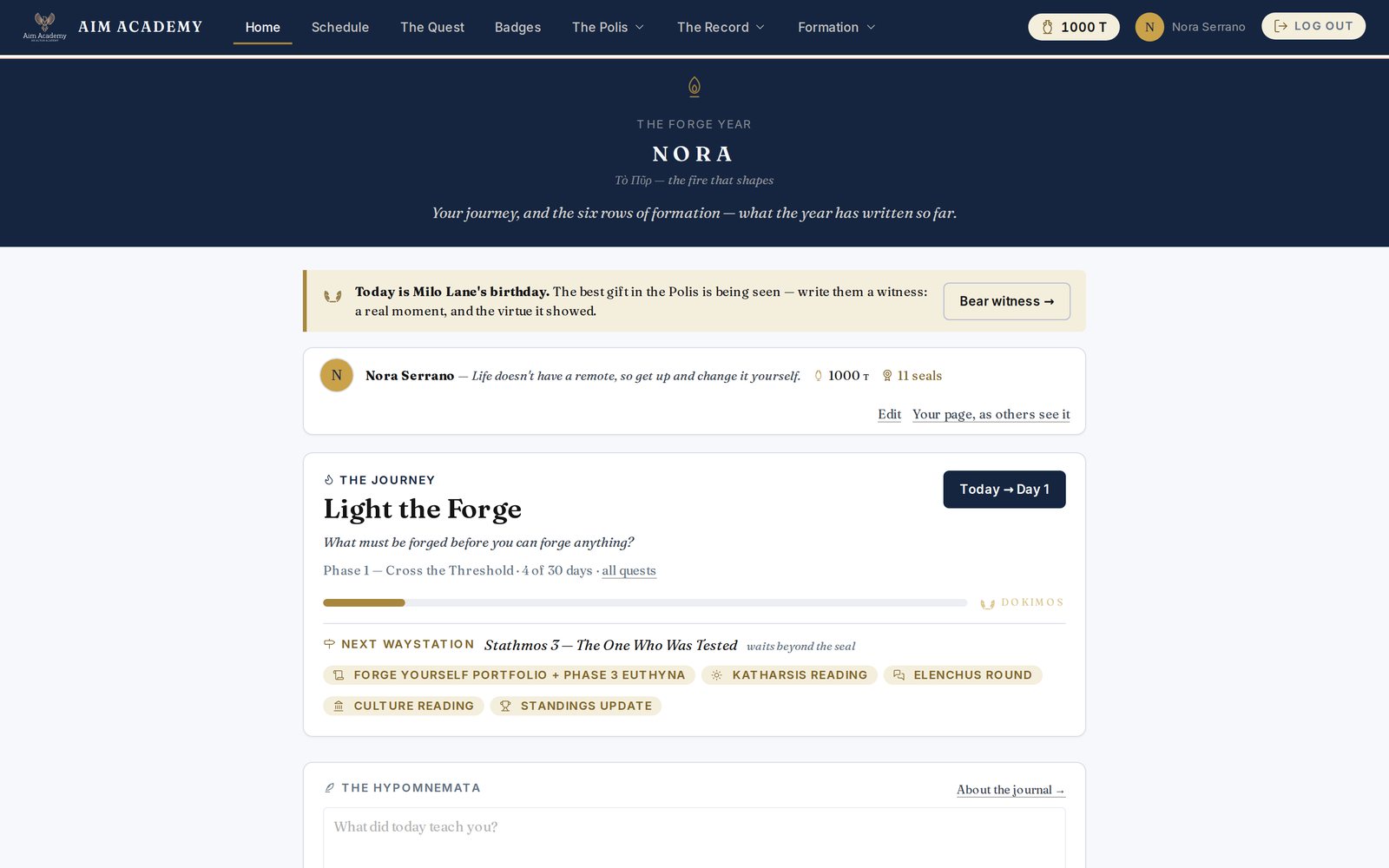
Students in a Crucible school are called citizens. Their home page is not a to-do list. It is the year so far: the quest they are walking, the next checkpoint, a journal that is private even from the teacher, the promise they made out loud, and the six rows of the record.
Every quest is a road with checkpoints — waystations. The page shows the phase, the day, the next waystation, and what it will take to pass it. The daily journal (the Hypomnemata) sits right underneath. Only the student can read it, unless they choose to share an entry.
Craft. Voice. Polis. Accountability. Shield. Endurance. Six rows, and every line in them was earned, witnessed, and sealed: verified works, stances taken in debate, offices held, audits stood, partners defended, days carried. It is the report card of a school that measures formation instead of compliance.
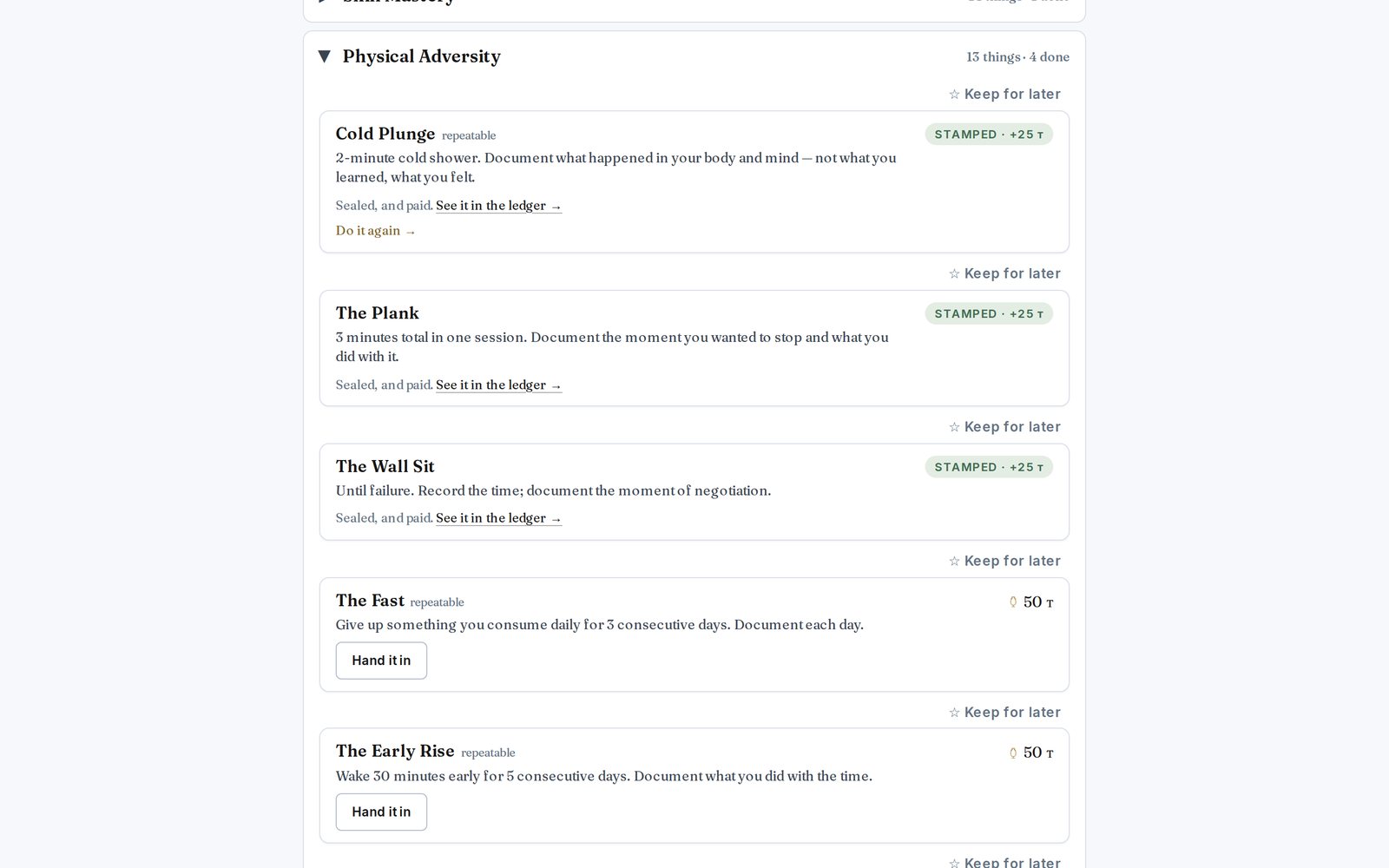
Every quest comes with a menu of challenges across twelve categories — physical adversity, public vulnerability, explicit failure, service to others, moral dilemmas, skill mastery, truth-seeking, leadership, and more. The badge says what must be shown; the student chooses how to show it, does the thing, documents it, and hands it in. Challenges that take gathering other people pay more, because gathering people is part of the work.
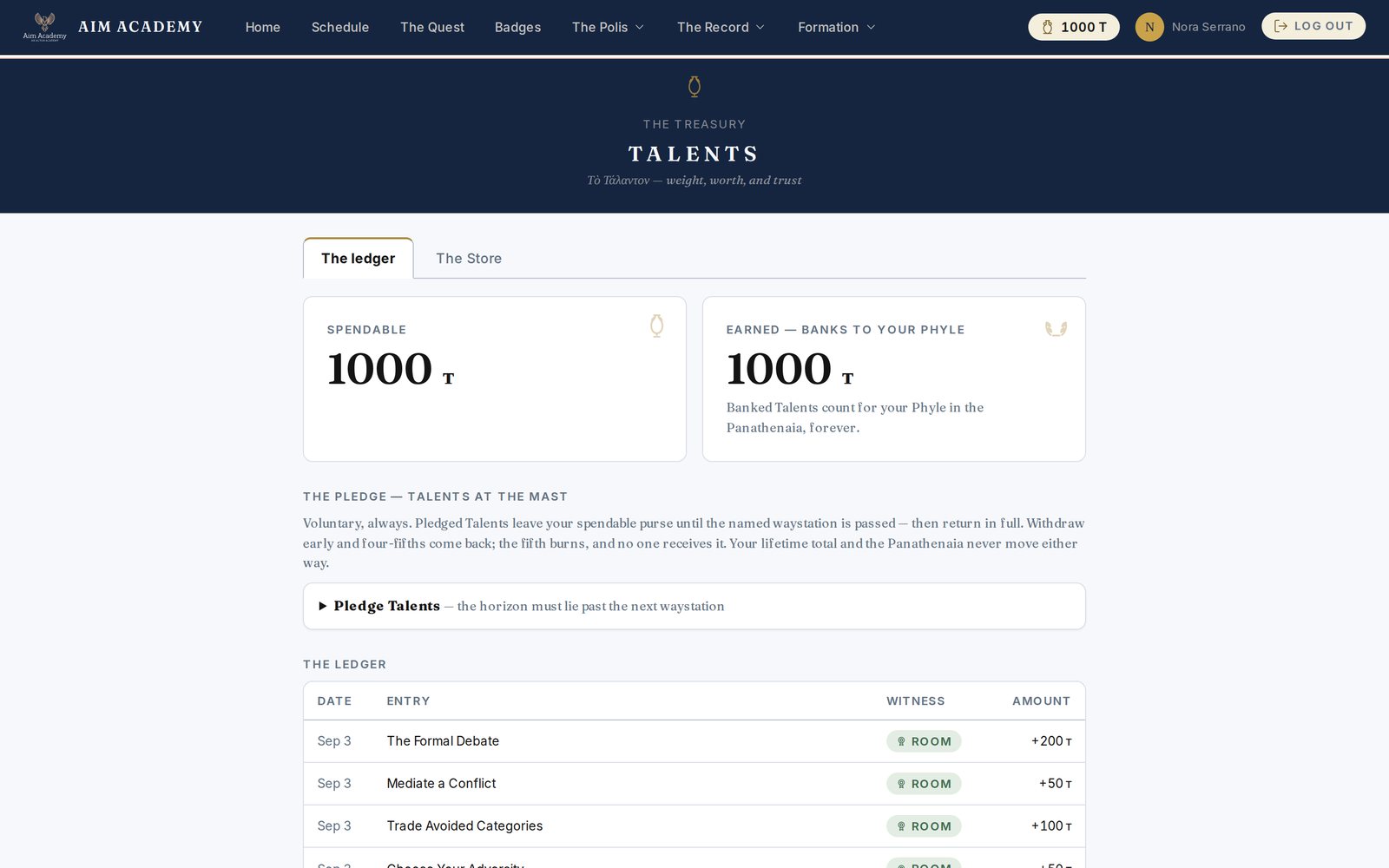
The Treasury. One currency — the Talent — with a ledger that names who witnessed each entry. A student can pledge Talents against the next waystation: pass it and they come back in full; quit early and a fifth of them burn.
The same five steps, whether the work is a cold plunge, a speech, a repaired friendship, or a built thing.
The student picks a challenge from the quest's menu, or takes on one of the badge's requirements.
A page, a photo, a recording, a witness's name — whatever the card asks for as proof.
The work goes to the room, not to a teacher's inbox. It counts the moment it is handed in.
Classmates witness the pieces. When a whole waystation is handed in, it is read together and sealed — by two room-mates in the older rooms, by the guide in the younger ones.
Talents are paid, the row fills, the badge plan's star lights, and the family's window and monthly report update on their own.
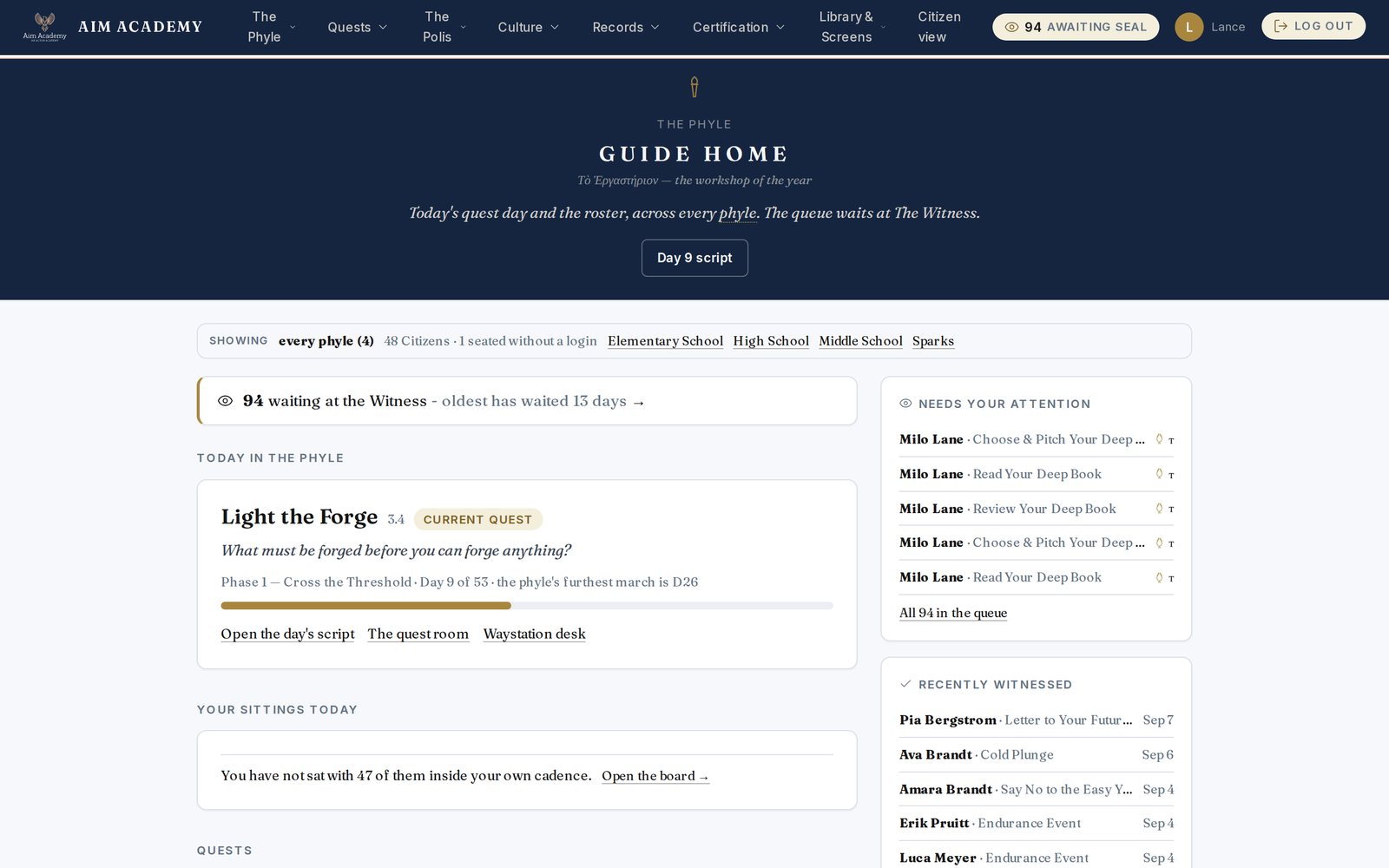
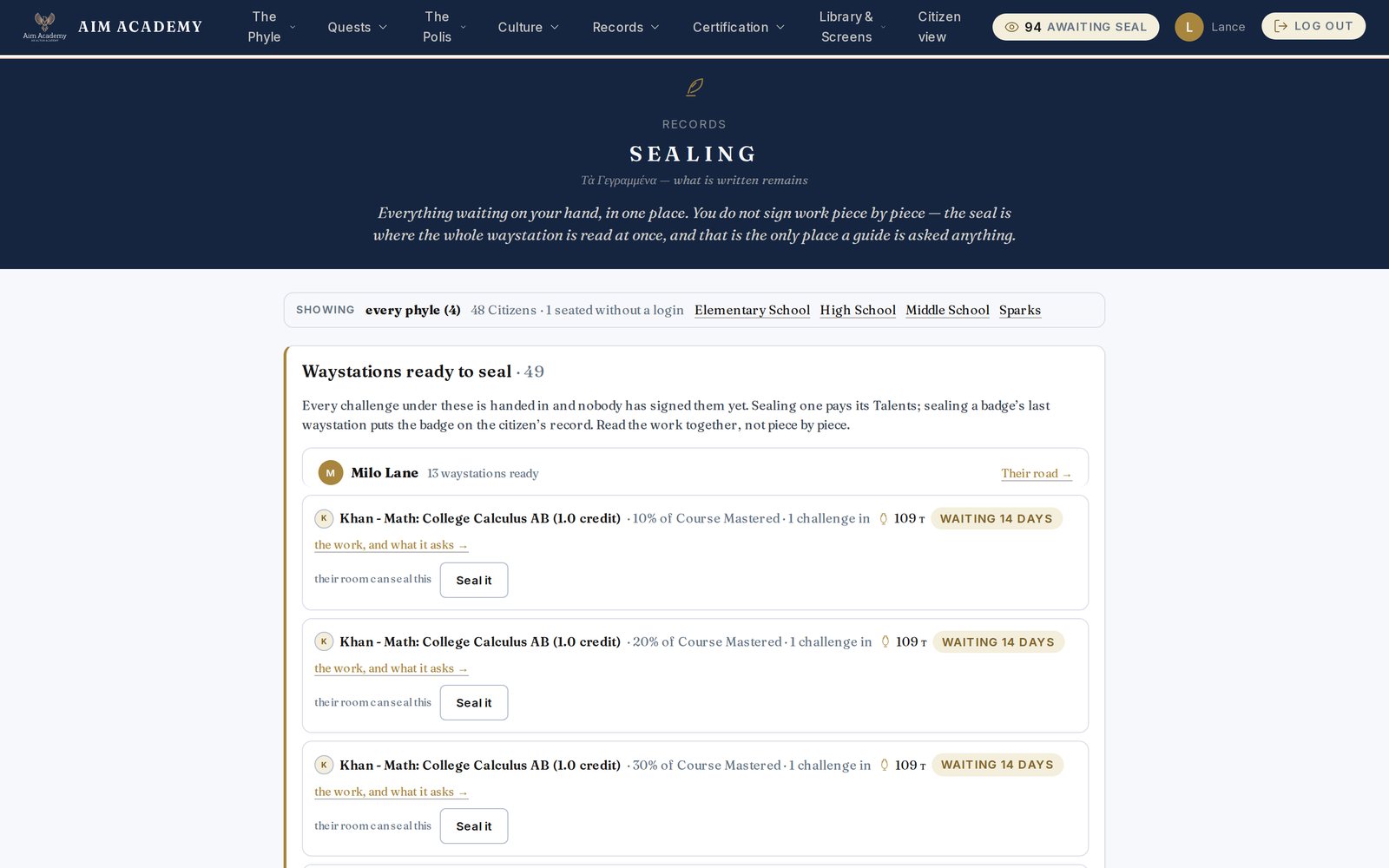
Crucible teachers are guides. Their home page carries today's quest day, the queue of work waiting to be witnessed, the one-on-one check-ins that are due, and the roster with every student's position and purse. A guide never grades a worksheet. The guide's one required act is the seal.
What day of the quest is it, what needs a witness, who has not sat with the guide lately, and where every student stands — on one screen. The day's script opens from here, and the quest room and waystation desk are one click away.
A guide does not sign work item by item. When every challenge under a waystation is handed in, the whole waystation is read at once and sealed — that is the check, and it is the only place a guide's approval is required. Sealing pays the Talents; sealing a badge's last waystation puts the badge on the record. In the older rooms, two classmates seal a waystation and the guide seals only the badge — which is why a Crucible teacher's evenings are not spent grading.
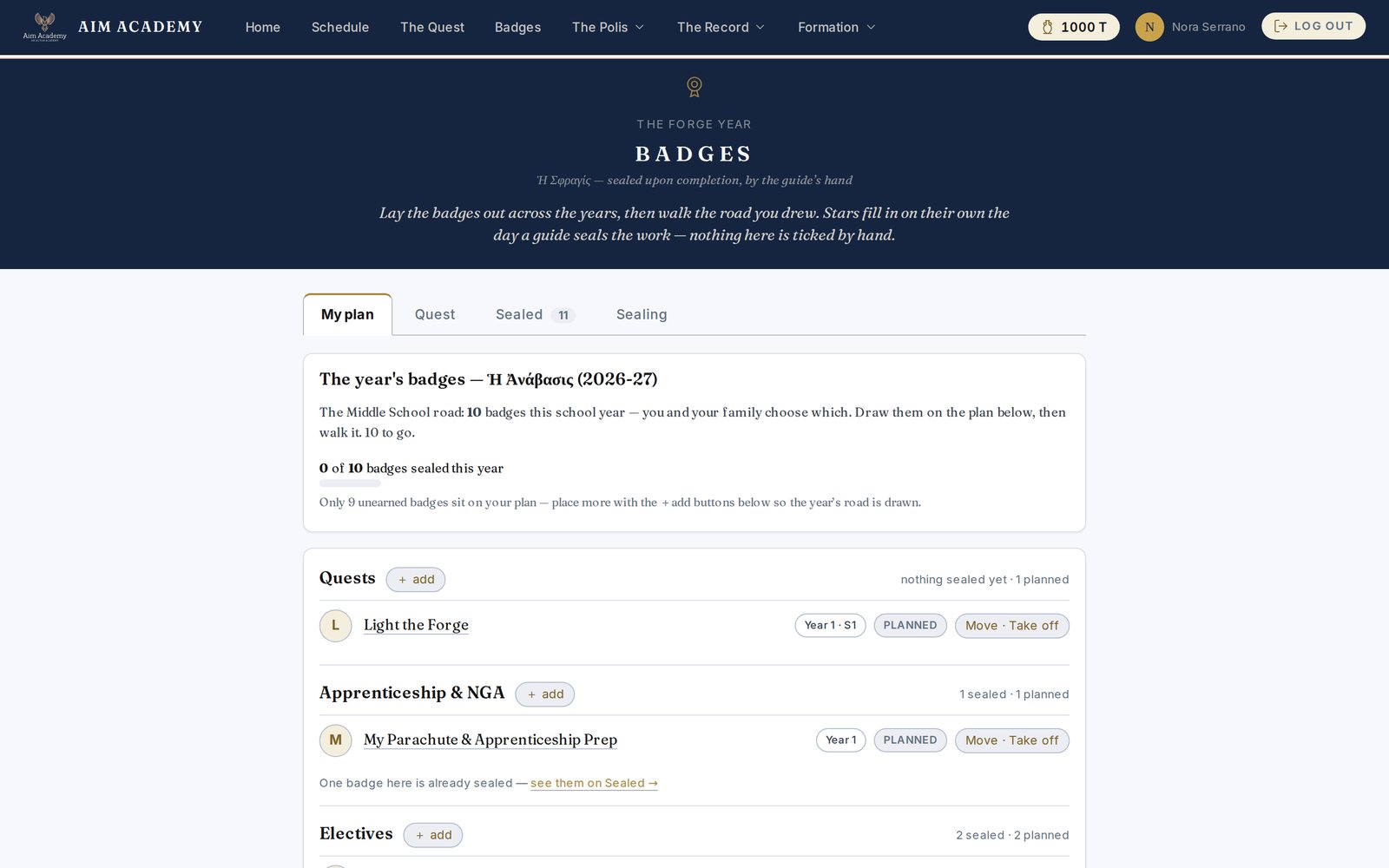
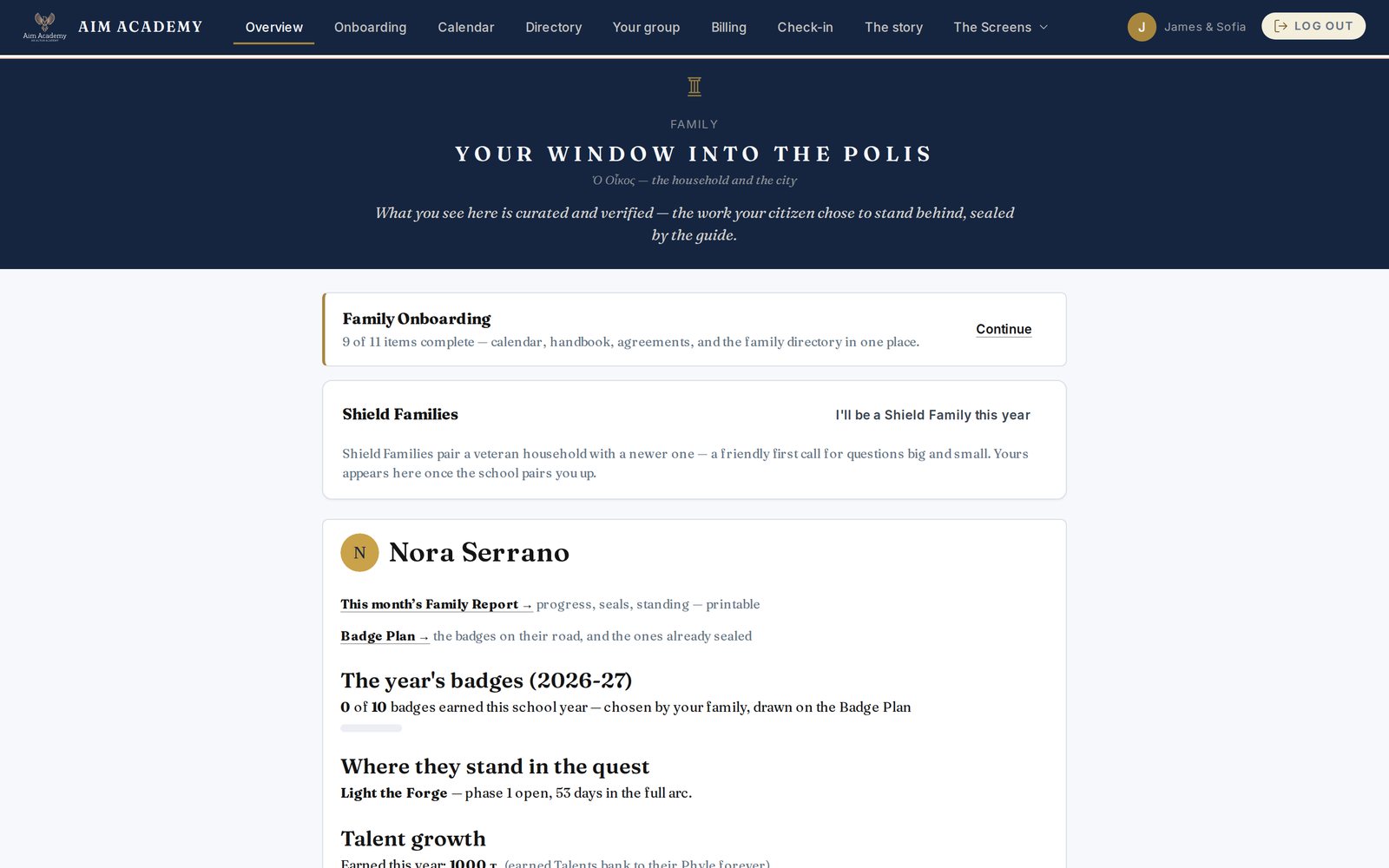
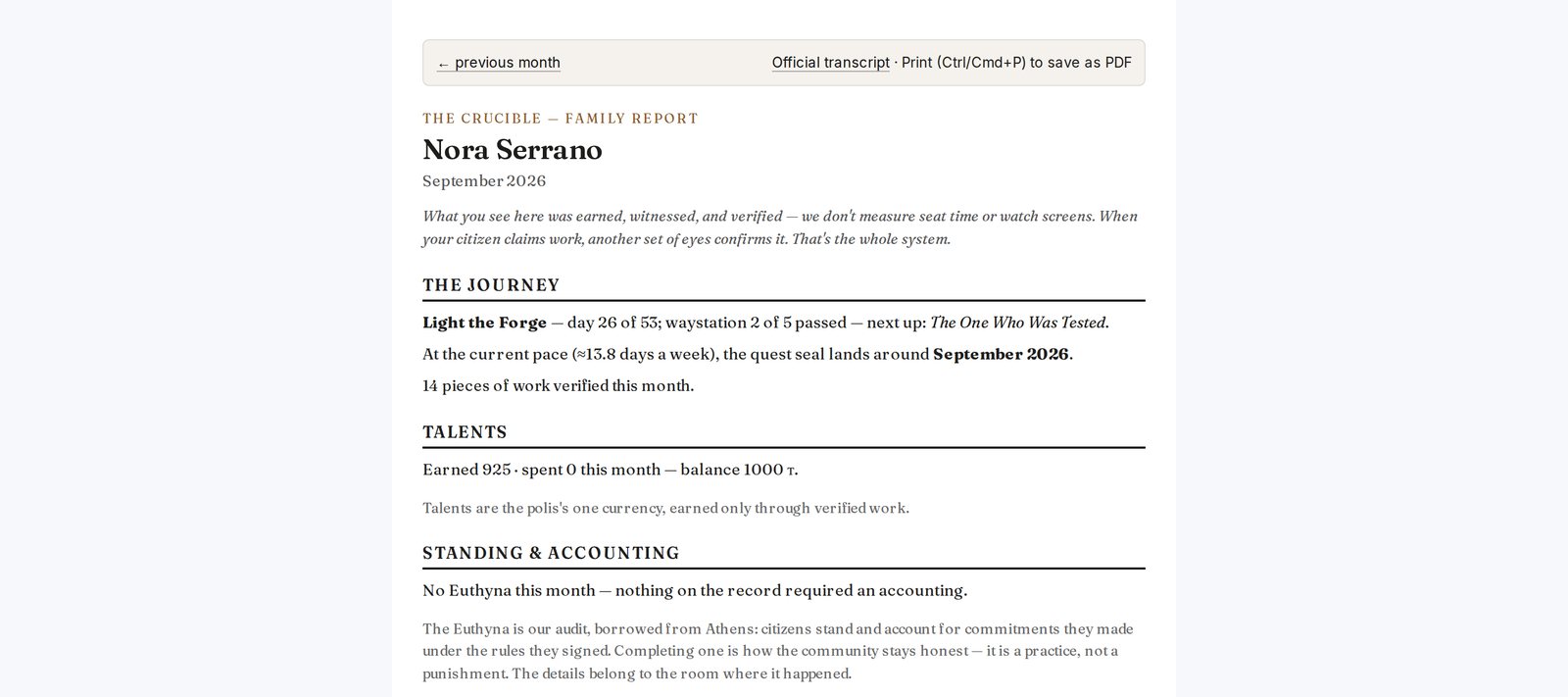
A family's window shows what their child chose to stand behind and what was sealed — the year's badges, where they stand in the quest, the Talents earned, and a monthly Family Report written in plain language.
Your window into the school. Onboarding, the family directory, the badge plan, and the record — curated and verified.
Everything in The Forge sits behind a login that belongs to the school. Nothing on it is on the open internet.
| What | Who can see it |
|---|---|
| The journal | The student only. A student may choose to share a single entry. |
| A piece of handed-in work | The student, the classmates who witness it, and the guide. |
| The record, the badges, the Talents | The student, the guide, and the student's family. |
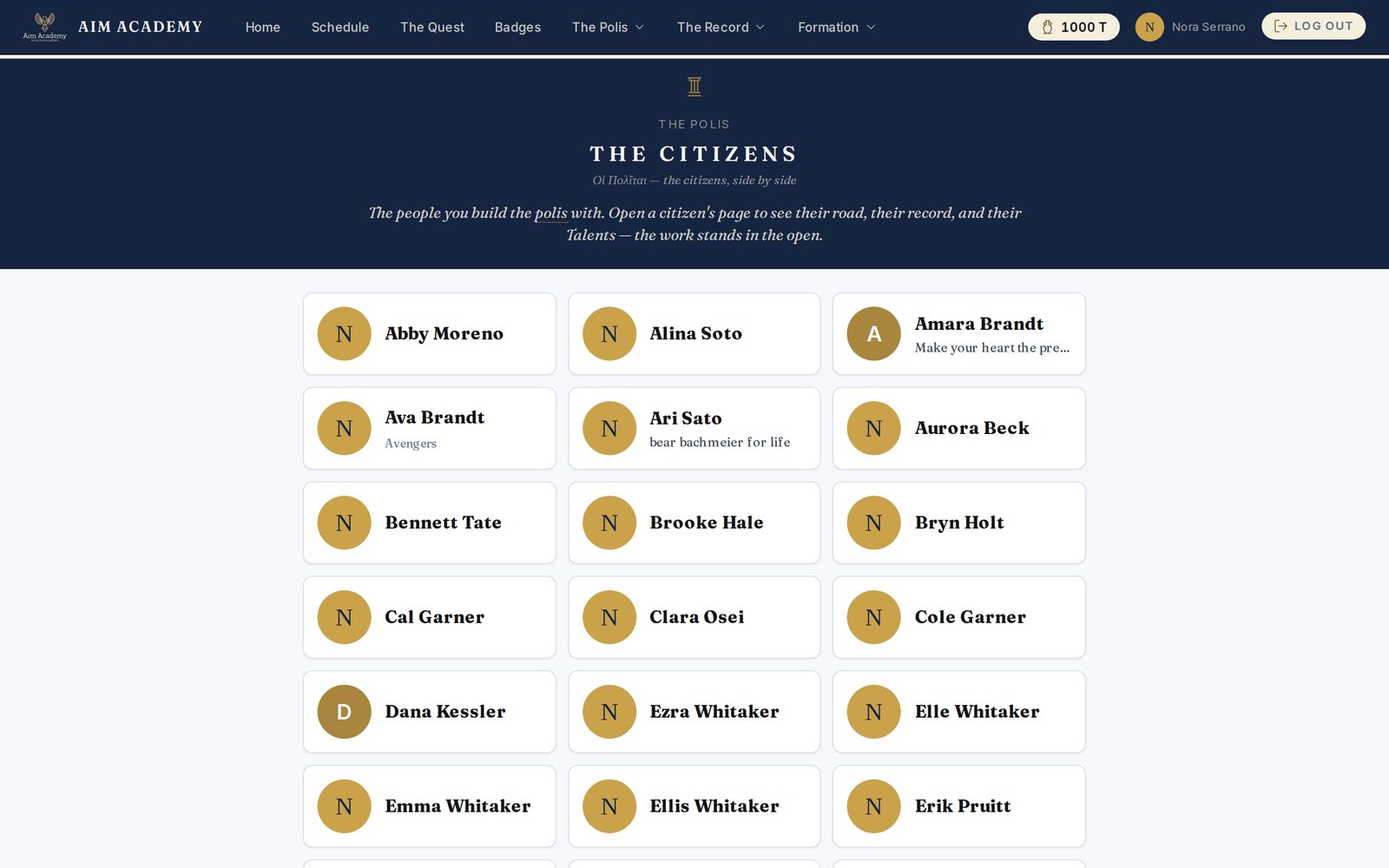
| A citizen's page | Other students and staff signed in to the same school — their road, their record, their Talents, as the school sees them. |
| The wall screens | The whole room. Totals only — never one child on the wall. |
Every student has a page the rest of the school can see — their road, their record, their Talents. Teams race all year on Talents earned. Students hold offices and hand them back. The rules the students write are the rules they answer to. And three screens on the wall show the room to itself — totals only, never one child.
Each school runs The Forge under its own name and colors. The screens on this page carry one partner school's.
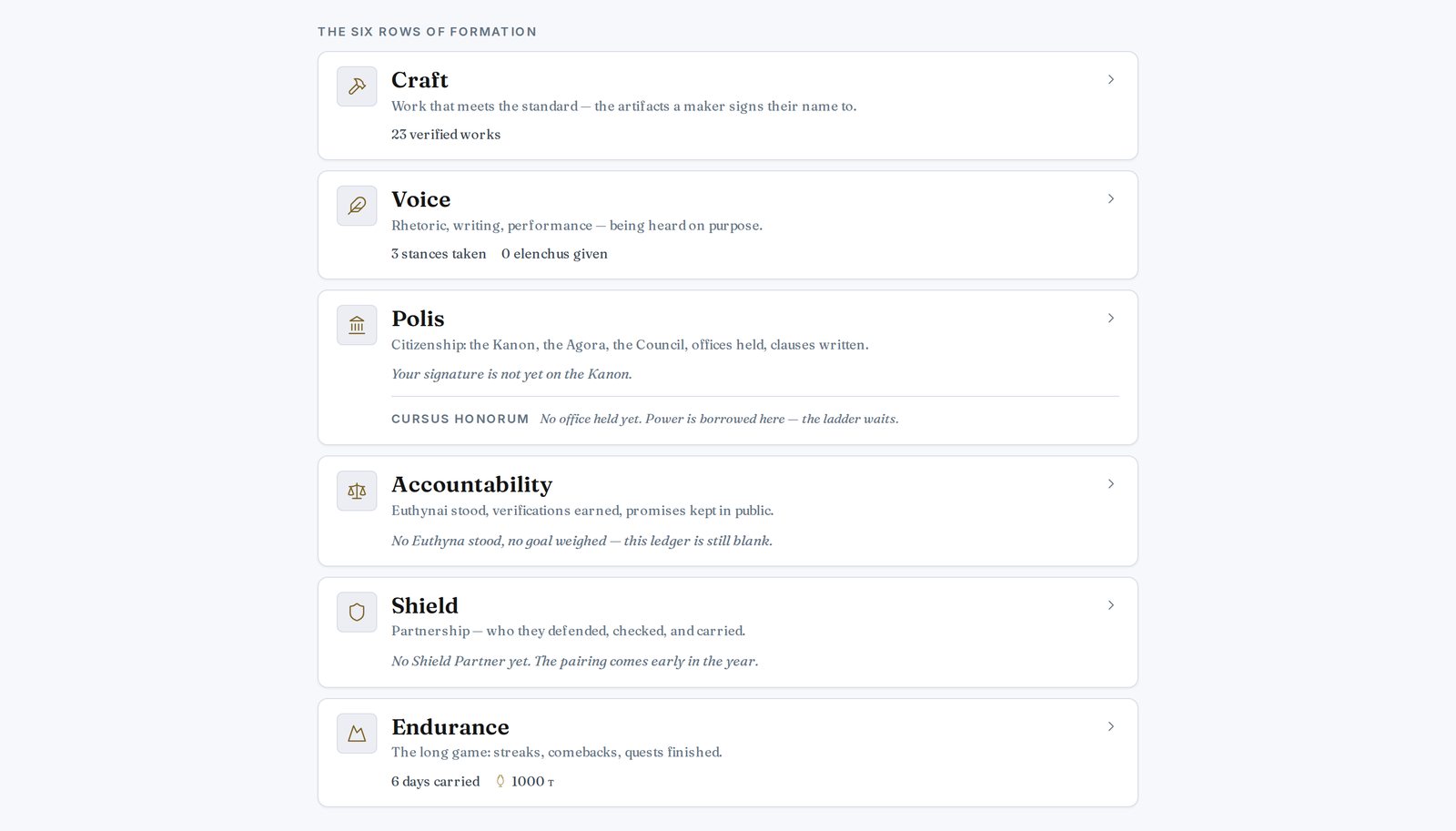
The Forge is not tied to one quest. Every Crucible quest — a marine-science expedition for nine-year-olds, a forensic case for middle schoolers, a real restaurant opened for one night — runs on the same road, the same seals, the same record.
There are no points for seat time, no due-date grid, no percentages. A row on the record fills only when work was handed in and sealed. The Forge runs alongside your gradebook and student information system; it replaces neither.
Quests are run in the room by a certified guide. The Forge carries the day's script, the work, and the record — it does not replace the room.
The journal is private even from the guide. The wall screens show the school, never a single child. Families see what their child chose to stand behind.
Students from elementary through high school, in charter, private, public and microschool settings — from one cohort of twenty-five to a whole building.
No. The Forge is the platform the Crucible Method runs on, and it comes with every partnership at no separate fee. It is not sold apart from the method.
We build your school's Forge — its name, colors, rooms and rosters — before the first day. Students get their logins in the room; families get theirs in a letter.
Every guide is certified before they run a room. The Forge is taught inside that certification and supported by the ongoing coaching membership — there is no separate software training.
The Forge does not replace your student information system. It produces a monthly Family Report and, for middle and high school, an official transcript of sealed work with credits — both printable as PDF.
Three parts: an annual per-student program license, one-time guide certification, and an annual coaching and support membership. We build your school's exact numbers together in a conversation — see Partner With Us.
The screens on this page are from a live partner school in the 2026–27 school year. Student and family names and photos have been changed.
Thirty minutes, live, with the founder driving. Lance Stewart · lance.stewart@thecrucibleinstitute.com · 801-390-3803
Schedule a Conversation